
CHAPTER eighteen
international trade
|
|
CHAPTER eighteen international trade |
CHAPTER OVERVIEWThis chapter introduces the basic principles
underlying the global economy. The INSTRUCTIONAL OBJECTIVES
1. Describe how international trade impacts our everyday lives.
2.
Define trade deficit and
trade surplus and describe the
3.
Compare the dollar value of
4.
List the major imports and exports of the
5.
Identify the
6.
Summarize the importance of international trade to the
7.
Describe the relative importance of 8. Explain the principles of comparative advantage, terms of trade, and gains from trade. 9. Compute, when given appropriate data, the relative costs of producing two commodities in two countries and determine which nation has the comparative advantage in each good. 10. Compute, when given appropriate data, the range for the terms of trade. 11. Calculate the potential gains from trade and specialization for each nation and the world when given appropriate data. 12. Graph and explain how foreign exchange rates are determined. 13. Explain what it means for a currency to appreciate or depreciate, and how a change in the international price of a currency can affect relative price levels and the exports and imports of a nation.
14.
Explain how 15. Describe approximately how much the U.S. dollar is worth relative to other nations. 16. Identify at least four ways in which governments interfere with free trade among nations. 17. Describe the economic impact of tariffs, including both direct and indirect effects. 18. Describe the political reasons that influence governments to impose trade barriers. 19. List three arguments in favor of protectionist barriers, and critically evaluate each. 20. Summarize the Smoot-Hawley Tariff Act, including its effects on the economy. 21. Explain the purpose and function of trade adjustment assistance, as well as criticisms of it.
22.
Describe offshoring and its effects on the trade
position of the 23. Describe the purposes of the GATT and the WTO and explain the criticisms of the WTO. 24. Identify the current round of WTO trade negotiations. 25. Explain what is meant by a trade bloc or a free-trade zone, and name two regional trade blocs.
26.
Describe the 27. Define and identify terms and concepts listed at the end of the chapter.
LECTURE NOTESI.
Trade Facts: Highlights A. In 2004 the B. The
principal exports of the C. D. The
E. Exports
of goods make up about 10% of total F. Although
the II.
Comparative Advantage and Specialization A. The
B. Adam Smith observed in 1776 that specialization and trade increase the productivity of a nation’s resources. His observation related to the principle of absolute advantage whereby a country should buy a good from other countries if they can supply it cheaper than we can. C. Basic principle of comparative advantage was first observed and explained in early 1800s by David Ricardo. This principle says that it pays for a person or a country to specialize and exchange even if that person or nation is more productive than potential trading partners in all economic activities. Specialization should take place if there are relative cost differences in production of different items. D. Example: A CPA can paint her house faster and better than a painter. She earns $50 per hour as accountant and can hire a painter for $15 per hour. The CPA can do the painting job in 30 hours; it takes the painter 40 hours. Should she hire the painter? On economic grounds, the opportunity cost is greater for the accountant to paint her house. She is better off to specialize in accounting rather than sacrifice 30 x $50, or $1500, to paint her house, when she can hire the painter for 40 x $15, or $600. The accountant will gain, and the painter will also gain because he is very inefficient in accounting. It may take him 10 hours to prepare his tax return, which would mean 10 x $15, or $150, in opportunity cost, whereas the accountant could probably complete the forms in 2 hours for a cost of $100. This example shows that even if a person (the accountant) has an absolute advantage in production of two products (painting and accounting), it is still advantageous to specialize and trade. The same is true for nations. E.
Comparative advantage and terms of trade:
Tables 18.1 and 18.2 illustrate the principle of comparative advantage
for two countries, 1. If the two nations specialize according to comparative advantage, then to get the other product they must trade. A nation has a comparative advantage in some product when it can produce that product at a lower domestic opportunity cost than can a potential trading partner. 2. Table 18.3 summarizes which nation has a comparative advantage in each product. 3. The rate of exchange of these two products will be determined through negotiation; the outcome is called the terms of trade. 4. The
terms of trade will be limited by the relative costs of production within each
country. The 5.
Somewhere between these limits, trade is possible.
In the text example, the terms of trade are assumed to be 3.5 tons of
avocados for each ton of soybeans.
Americans would specialize in soybeans only if they could obtain more than 3
tons of avocados for 1 ton of soybeans by trading with F. Gains from specialization and trade: 1. Table
18.4, column 1, shows the (hypothetical) optimal outputs for 2. Column 2 of Table 18.4 shows the amount each country produces when it specializes. 3. Column 3 of Table 18.4 shows quantities in each country after trade takes place at the rate of 1S = 3.5A. 4. 5. Now each
country will have more than they had originally:
6. This
example illustrates that specialization and trade can improve overall output
even when one country ( III.
The Foreign Exchange Market A. In a foreign exchange market, various national currencies are exchanged for one another so that international trade can take place. Germans want euros, Mexicans want pesos, and the Japanese want yen when they sell their products. B. Two points require emphasis with respect to these markets. 1. Real‑world foreign exchange markets are competitive, with large numbers of buyers and sellers dealing with a standardized product, the currency of some country. 2. Exchange rates link domestic (one country’s) prices with all foreign prices. They enable you to translate the price of foreign products into dollars. For example, if the dollar/yen exchange rate is 1 cent/per yen, a Sony T.V. set priced at ¥20,000 will cost an American $200 = (20,000 x .01).
C.
Global
Snapshot 18.3 provides a sampling of exchange rates of foreign
currencies per D. The dollar‑pound exchange market is depicted in Figure 18.1. The demand for British pounds and the supply of pounds curve will establish the equilibrium dollar price of pounds. 1. The demand-for-pounds curve is negatively sloped – If pounds become less expensive, holders of U.S. dollars will want to buy more of them because British goods will have become relatively less expensive. 2. The supply-of-pounds curve is positively sloped – When the dollar price of a pound rises (meaning dollars have become cheaper), holders of pounds will want more U.S. dollars (because U.S. goods are now cheaper) and are willing to provide more pounds to get them. E. Changing rates: Appreciation and Depreciation. 1. If the
dollar price of pounds rises, that means the dollar has depreciated relative to
the pound. The result is that
British goods would become more expensive to Americans and 2. If the opposite occurred and the dollar price of pounds falls, then the dollar has appreciated relative to the pound. Americans will purchase a greater quantity of British products because they have become less expensive in dollar terms. F. Determinants of Exchange Rates 1. Three general factors combine to appreciate or depreciate a currency: a. If the demand for a nation’s currency increases, the currency will appreciate; if demand falls, the currency will depreciate. b. If the supply of a nation’s currency increases, the currency will depreciate; if supply fall, the currency will appreciate. c. If a country’s currency appreciates (depreciates), some foreign currencies have depreciated (appreciated) relative to it. 2. Factors that shift the demand or supply curve for a currency: a. Tastes – increased preference for the goods of a country will increase demand for the currency needed to buy those goods and appreciate that country’s currency. At the same time, the importing nations are supplying more of their currency, causing them to depreciate relative to the nation with the preferred goods. b. Relative income – An increase in a nation’s relative income will increase its demand for imports, increasing the demand for foreign currency. The appreciation in the foreign currency means the rising relative income is causing depreciation in the domestic currency. c. Relative price levels – An increase in the domestic price level relative to foreign price levels will cause a currency to depreciate as the nation supplies more of its currency to buy foreign goods, and foreign buyers demand less of the currency. d. Relative interest rates – A nation with rising relative interest rates will attract financial investment. This will increase the demand for the currency and cause an appreciation. Foreign investors will increase the supply of their currencies to the market, causing theirs to depreciate. e. Speculation – If currency speculators believe that a currency will appreciate, they will purchase more of that currency now in an attempt to reap profits when they sell them in the future. This effort increases the demand for the currencies projected to appreciate, causing them to appreciate in a self-fulfilling prophecy. IV.
Government and Trade A. Types of barriers: 1. Protective tariffs are implemented to insulate domestic producers from foreign competition by raising import prices. 2. Import quotas specify the maximum amounts of imports allowed in a certain period of time. Low import quotas may be a more effective protective device than tariffs, which do not limit the amount of goods entering a country. 3. Nontariff barriers refer to licensing requirements, unreasonable standards, or bureaucratic red tape in customs procedures.
4. Voluntary export
restrictions are agreements by foreign firms to “voluntarily” limit their
exports to a particular country. 5. Export subsidies are payments to domestic producers of export goods. They reduce production costs and allow producers to lower prices and export more in world markets. B. Economic impact of tariffs – direct effects 1. When the tariff is imposed, domestic consumption declines. (Law of demand) 2. Domestic production will rise because the price has risen. (Law of supply) 3. Imports fall, hurting foreign producers. 4. Government tariff revenue will represent a transfer of income from consumers to government. C. Economic impact of tariffs – indirect effects 1. Domestic producers that rely on imported inputs face higher costs and will produce less with tariffs on those inputs. 2. Reduced foreign competition reduces the incentives to innovate in production techniques and new products. 3. Relatively efficient export industries are made to contract; relatively inefficient industries are encouraged to expand. D. Net costs of tariffs 1. Tariffs raise prices in three ways: a. Prices of imported products rise. b. Consumers shift to higher-priced domestically produced goods. c. Prices of domestically produced goods rise because of reduced import competition. 2. In addition to the direct and indirect efficiency losses already identified, companies devote significant resources to gaining or maintaining tariff protection. These resources are diverted from more socially desirable purposes. E. Why do governments enact trade barriers? 1. They don’t understand the benefits from international trade and see only the damage in certain industries that can’t compete successfully with imports. 2. Political considerations are important because consumers don’t see the effects of a tariff or quota directly, but they do see the impact of import competition on some workers. Also, the benefits of free trade tend to be spread among all consumers, but the benefits of a protective policy are realized almost immediately in the short run by the affected industry may have a large and vocal stake in the outcome. F. Illustrating the Idea: Buy American? Taken to its logical conclusion, the argument to “buy American” is a case for total self- sufficiency, a condition that would leave most if not all of us worse off. V. Three Argument for Protectionism A. Military self‑sufficiency may be a valid political‑economic argument for protecting industries that are critical to national defense. Likewise, protecting “infant industries” may have some merit. The three that follow are commonly cited yet generally unsupported by economic theory: B. Increasing domestic employment is the most popular reason for protection, but there are important shortcomings associated with this reasoning. 1. Imports may eliminate some jobs, but they create others in the sales and service industries for these products. 2. The fallacy of composition applies here. The imports of one nation are the exports of another. By achieving short‑term employment goals at home, the trading partner may be made weaker and less able to buy the protectionist nation’s products. 3. Retaliation is a risk that occurred in the 1930s when high tariffs were imposed by the U.S. Smoot‑Hawley Tariff Act of 1930. Protectionism against American goods will hurt our export industries. Such trade wars still erupt today although the WTO helps to eliminate the problem. C. Protection is said to be needed against the competition from cheap foreign labor. However, this argument is not valid. It is mutually beneficial for rich and poor to trade with one another. By not trading, we don’t raise our living standards at all, but we will decrease them by shifting labor into inefficient areas where the foreign labor could have produced the items more efficiently. D. Protection
against “dumping” is another argument for tariffs when nations “dump” excess
products onto 1. These
firms may be trying to drive out 2. Dumping can be a form of price discrimination. 3. Dumping
is a legitimate concern and is prohibited under trade laws of the |
| DEMAND Law of Demand CHANGE IN P= CHANGE IN Qd INVERSE
CHANGE IN NPD= CHANGE IN D
CHANGE IN D CHANGE IN D |
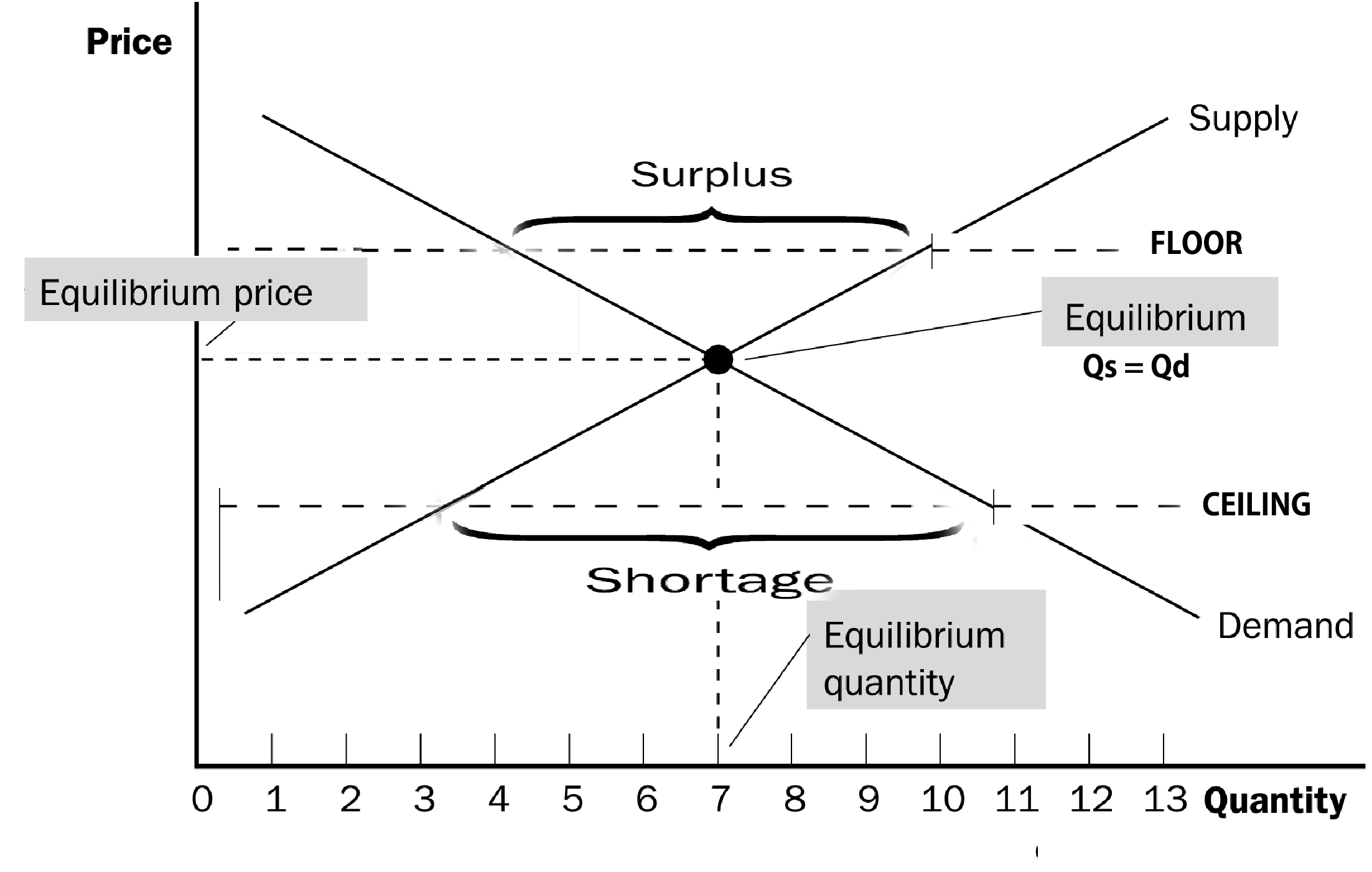 |
SUPPLY Law of Supply CHANGE IN P = CHANGE IN Qs DIRECT
CHANGE IN NPD= CHANGE IN S
CHANGE IN S CHANGE IN S
|
 = P
= P = P
= P