The business cycle refers to the ups and downs seen somewhat
simultaneously in most parts of an economy. The
cycle involves shifts over time
between periods of relatively rapid growth of output (recovery
and prosperity), alternating with periods of relative stagnation
or decline (contraction or
recession). These fluctuations
are often measured using total national production or the
real
gross domestic product.

To call those shifts "cycles" is rather misleading as they
don't tend to repeat at fairly regular time intervals. Most observers
find that their lengths (from peak to peak, or from trough to trough)
vary, so that cycles are not mechanical in their regularity. Since no
two cycles are alike in their details, some economists dispute the
existence of cycles and use the word "fluctuations" (or the like)
instead. Others see enough similarities between cycles that the cycle is
a valid basis of studying the state of the economy. A key question is
whether or not there are similar mechanisms that generate
recessions and/or booms that exist in
capitalist economies so that the
dynamics that appear as a cycle will be seen again and again.
Business Cycles
In the typical "business cycle" recovery and prosperity are
associated with increases in productivity, consumer confidence,
aggregate demand, and prices. In the
cycles before
World War II or that of the late
1990s in the United States, the growth
periods usually ended with the failure of speculative investments built
on a bubble of confidence that bursts or deflates. In these cycles, the
periods of contraction and stagnation reflect a purging of unsuccessful
enterprises as resources are transferred by market forces from less
productive uses to more productive uses. Cycles between 1945 and the
1990s in the United States were generally more restrained and followed
political factors, such as
fiscal policy and
monetary policy.
Automatic stabilization due the
government's
budget helped defeat the cycle even
without conscious action by policy-makers.
Traditional Business Cycle
models
The main types of business cycles enumerated by
Karl Marx,
Joseph Schumpeter and others
in this field have been named as follows:
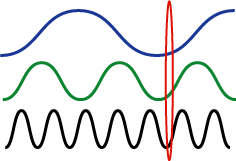
- the Seasonal transitional cycle
(annual)
- the Kitchen
investment cycle
(3-5 years)
- the Juglar
infrastructural cycle (7-11 years)
- the
Kondratiev wave
or technological cycle (45-60 years)
TABLE 1
|
Business Cycle
Peaks and Troughs in the United States
1890-1992
|
| Peak
|
Trough
|
|
Peak
|
Trough
|
| July 1890
|
May 1891
|
|
Aug. 1929
|
Mar. 1933
|
| Jan. 1893
|
June 1894
|
|
May 1937
|
June 1938
|
| Dec. 1895
|
June 1897
|
|
Feb. 1945
|
Oct. 1945
|
| June 1899
|
Dec. 1900
|
|
Nov. 1948
|
Oct. 1949
|
| Sep. 1902
|
Aug. 1904
|
|
July 1953
|
May 1954
|
| May 1907
|
June 1908
|
|
Aug. 1957
|
Apr. 1958
|
| Jan. 1910
|
Jan. 1912
|
|
Apr. 1960
|
Feb. 1961
|
| Jan. 1913
|
Dec. 1914
|
|
Dec. 1969
|
Nov. 1970
|
| Aug. 1918
|
Mar. 1919
|
|
Nov. 1973
|
Mar. 1975
|
| Jan. 1920
|
July 1921
|
|
Jan. 1980
|
July 1980
|
| May 1923
|
July 1924
|
|
July 1981
|
Nov. 1982
|
| Oct. 1926
|
Nov. 1927
|
|
July 1990
|
Mar. 1991
|
|
Preventing Business Cycles
Because the periods of stagnation are painful for many who lose their
jobs, pressure arises for politicians to try to smooth out the
oscillations. An important goal of all Western nations since the
Great Depression has been to limit the
cycles through fiscal and monetary policies. Government intervention in
the economy can be risky, however. For instance, some of
Herbert Hoover's efforts (including tax
increases) are widely, though not universally, believed to have deepened
the depression.
Classical economic theory---as explained by Schumpeter
and others--states that no deterministic cycle can
persist because it would consistently create
arbitrage
opportunities, and holds that the economy always moves
back to long-run
equilibrium at full
employment. This view holds to the idea that
observed economic fluctuations can be modeled as
short-term periods of disequilibrium which serve as
necessary adjustments in a dynamic economic system, and
that these periods of disequilibrium would be naturally
corrected through changes in prices, wages, and interest
rates. In this theory, any government involvement
would actually be detrimental to the efficient
functioning of the free market.
In
Keynesian theory,
however, general trends can overwhelm the behavior of
individuals. Instead of the economic process being based
on continuous improvements in
potential output, as
most
classical economists
believed, Keynes asserted the importance of
aggregate demand for
goods as the driving
factor of the
economy, especially in
periods of downturn. From this he argued that government
policies could be used to promote demand at a macro
level in order to fight high
unemployment and
deflation of the sort
seen during the
1930s.
A central conclusion of Keynesian economics is that
there is no strong automatic tendency for output and
employment to move toward
full employment levels.
This idea conflicts with the general assumption of
classical economics that predicts a general tendency
towards
equilibrium in an
efficient economy. Keynes's theory suggested that active
government policy could be effective in managing the
economy. Rather than seeing unbalanced government
budgets as wrong, Keynes advocated what are called
counter-cyclical fiscal policies, that is policies which
act against the tide of the
business cycle:
deficit spending when a
nation's economy suffers from
recession or when
recovery is long-delayed and unemployment is
persistently high—and the suppression of inflation in
boom times by either increasing taxes or cutting back on
government outlays. He argued that governments should
solve short-term problems rather than waiting for market
forces to do it, because "in the long run, we are all
dead."
No one argues that managing
economic policy to even out the cycle
is not an easy job in a society with a complex economy. According to
some theorists, notably nineteenth-century advocates of
communism, this difficulty is
insurmountable.
Karl Marx in particular claimed that
the recurrent business cycle
crises of
capitalism were inevitable results of
the system's operations. In this view, all that the government can do is
to change the timing of economic crises. The crisis could also
show up in a different form, for example as severe
inflation or a steadily increasing
government deficit. Worse, by delaying
a crisis, government policy is seen as making it more dramatic
and thus more painful.
Politically-based business
cycle models
 Classical and Neo-classical theorists
also believe that government stabilization efforts through monetary and fiscal
policy are difficult to use with any precision. There are long lags in
the implementation and effect of changes in spending, taxes, and
monetary stance. There is also significant uncertainty about how much of
a monetary or fiscal stimulus is needed to end a recession of a
particular severity. Finally, policymakers also often have conflicting
goals. Because inflation tends to slow down in recessions and speed up
in booms, policymakers cannot cure the dual problems of inflation and
unemployment with the same policy tools. As a result they often seem to
adopt the strategy of fighting inflation with tight policy and then
reducing unemployment with a switch to loose policy.
Classical and Neo-classical theorists
also believe that government stabilization efforts through monetary and fiscal
policy are difficult to use with any precision. There are long lags in
the implementation and effect of changes in spending, taxes, and
monetary stance. There is also significant uncertainty about how much of
a monetary or fiscal stimulus is needed to end a recession of a
particular severity. Finally, policymakers also often have conflicting
goals. Because inflation tends to slow down in recessions and speed up
in booms, policymakers cannot cure the dual problems of inflation and
unemployment with the same policy tools. As a result they often seem to
adopt the strategy of fighting inflation with tight policy and then
reducing unemployment with a switch to loose policy.
While government policy may not have
cured the business cycle, the effects of cycles on individuals in the
United States and other industrialized countries almost surely have been
lessened in recent decades. The advent of unemployment insurance and
other social welfare programs means that recessions no longer wreak the
havoc on individuals' standards of living that they once did.
However, another set of models tries to
derive the business cycle from political decisions designed to solve the
problem of business cycles:
The
partisan business cycle suggests that
cycles result from the successive elections of administrations with
different policy regimes. A government adopts expansionary policies,
resulting in growth and inflation, but is voted out of office when
inflation becomes unacceptably high. The replacement government adopts
contractionary policies reducing inflation and growth, and the downwards
swing of the cycle. It is voted out of office when unemployment is too
high, being replaced by another government.
The
political business cycle is an
alternative theory stating that when an administration is elected, it
initially adopts a contractionary policy to reduce inflation and gain a
reputation for economic competence. It then adopts an expansionary
policy in the lead up to the next election, hoping to achieve
simultaneously low inflation and unemployment on election day.
Copyright: Design and
coding ©: 2004,
Liberty
Fund, Inc.
Content ©: 1993, 2002 David R. Henderson. All rights reserved.
 Leadership Focus