 |
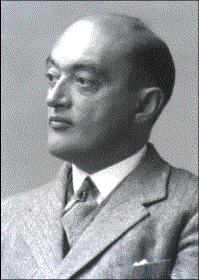
Joseph
Schumpeter (1883-1950) |
|
"Can capitalism survive? No. I do not think it can." Thus opens Schumpeter's prologue to a section of his 1942 book, Capitalism, Socialism and Democracy. One might think, on the basis of the quote, that Schumpeter was a Marxist. But the analysis that led Schumpeter to his conclusion differed totally from Karl Marx's. Marx believed that capitalism would be destroyed by its enemies--the proletariat, whom capitalism had deliberately exploited. Marx relished the prospect. Schumpeter believed that capitalism would be destroyed by its successes. Capitalism would spawn, he believed, a large intellectual class that made its living by attacking the very bourgeois system of private property and freedom so necessary for the intellectual class's existence. And unlike Marx, Schumpeter did not relish the destruction of capitalism. He wrote: "If a doctor predicts that his patient will die presently, this does not mean that he desires it." Born in Austria to parents who owned a textile factory, Schumpeter was very familiar with business when he entered the University of Vienna to study economics and law. At the age of twenty-eight he published his famous Theory of Economic Development. In 1911 Schumpeter took a professorship in economics at the University of Graz. He served as minister of finance in 1919. With the rise of Hitler, Schumpeter left Europe and the University of Bonn, where he was a professor from 1925 until 1932, and emigrated to the United States. In that same year he accepted a permanent position at Harvard, where he remained until his retirement in 1949. Schumpeter was president of the American Economic Association in 1948. Capitalism, Socialism, and Democracy was much more than a prognosis of capitalism's future. It was also a sparkling defense of capitalism on the grounds that capitalism sparked entrepreneurship. Indeed, Schumpeter was among the first to lay out a clear concept of entrepreneurship. He distinguished inventions from the entrepreneur's innovations. Schumpeter pointed out that entrepreneurs innovate, not just by figuring out how to use inventions, but also by introducing new means of production, new products, and new forms of organization. These innovations, he argued, take just as much skill and daring as does the process of invention. Innovation by the entrepreneur, argued Schumpeter, led to gales of "creative destruction" as innovations caused old inventories, ideas, technologies, skills, and equipment to become obsolete. The question, as Schumpeter saw it, was not "how capitalism administers existing structures,... [but] how it creates and destroys them." This creative destruction, he believed, caused both the highs and the lows of a self-correcting business cycle: the misery and unemployment of depressions as well as tremendous progress and improved standards of living for everyone. Schumpeter argued with the prevailing view that "perfect" competition was the way to maximize economic well-being. Under perfect competition all firms in an industry produced the same good, sold it for the same price, and had access to the same technology. Schumpeter saw this kind of competition as relatively unimportant. He wrote: "[What counts is] competition from a new commodity, a new technology, a new source of supply, a new type of organization... competition which... strikes not at the margins of the profits and the outputs of the existing firms but at their foundations and their very lives." Schumpeter argued on this basis that some degree of monopoly was preferable to perfect competition. Competition from innovations, he argued, was an "ever-present threat" that "disciplines before it attacks." He cited the Aluminum Company of America as an example of a monopoly that continuously innovated in order to retain its monopoly. By 1929, he noted, the price of its product, adjusted for inflation, had fallen to only 8.8 percent of its level in 1890, and its output had risen from 30 metric tons to 103,400. Schumpeter never made completely clear whether he believed innovation was sparked by monopoly or, rather, by the prospect of getting a monopoly as the reward for innovation. Most economists accept the latter argument and, on that basis, believe that companies should be able to keep their production processes secret, have their trademarks protected from infringement, and obtain patents. Selected Works
Business Cycles, 2 vols. 1939. Capitalism, Socialism and Democracy, 5th ed. 1976. History of Economic Analysis, edited by E. Boody. 1954. Ten Great Economists. 1951. The Theory of Economic Development. 1912. Translated by R. Opie, 1934. Reprint. 1961.
|